
Santiago Calatrava - London & Venice Architecture
Even the most hardened retronaut would say that the majority of buildings on City Point Square off Moorgate in the City of London are unremarkable. Grey 1960s boxes line two of the three built-on sides of the square.
The third built-on side is, however, different. Dramatic late 1990s cladding flies up to 35 floors and then arches out into a lip at roof level that resembles the superstructure of an ocean liner.
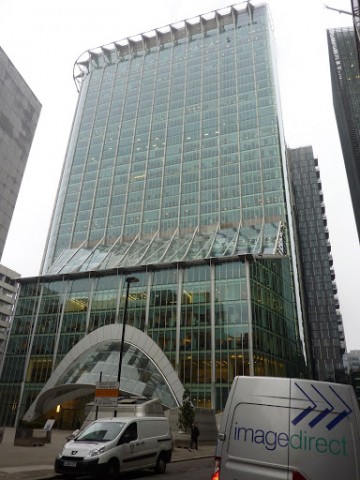
This is re-cladding. Without it the former BP building would look as sad as the rest of its City Point compatriots.
And the most dramatic element of the design is probably the vast ground floor canopy, which amongst other things provides shelter from the rain as well as protection for the smoking classes.
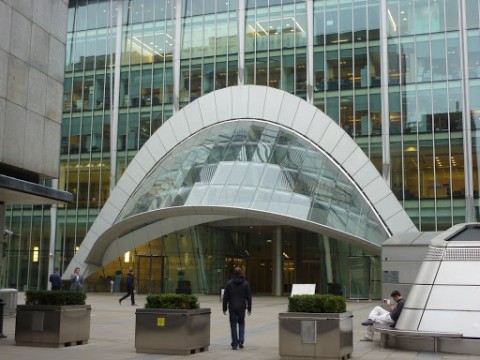
Seen that canopy somewhere else? Yes, for fans of the Caped Crusader, it was the entrance to the Gotham City Restaurant in Batman Begins.
How the building, the eponymous City Point, came to its form today, is another story, but the point for this blogpost is that the external design is the work of the Spanish architect, Santiago Calatrava.
Born in 1951, Calatrava is a controversial figure. Responsible for projects including the roof of the Athens Olympic Stadium and airports in Bilbao in Spain and Denver in the US, he was reported in a Guardian article of May this year as having been severely criticised for the alleged £81m bill from his practice for designing the City of Arts and Sciences in Valencia – criticism incidentally that Calatrava has strongly refuted.
For a look in mainland Europe at another, and controversial, Calatrava design, we will go not to Spain but to Venice.
Before the construction of the 94 metre Ponte della Costituzione, the good citizens of the City had a problem. The train station and bus station stand virtually opposite each other, but in the middle is the Grand Canal.
Getting from one to the other by land required a trek down to and across the Ponte Scalzi, some 400 metres away down the Canal. The alternative was a “traghetto” trip across from one side to the other – think watermen in the days when there was no central bridge in London other than London Bridge itself.
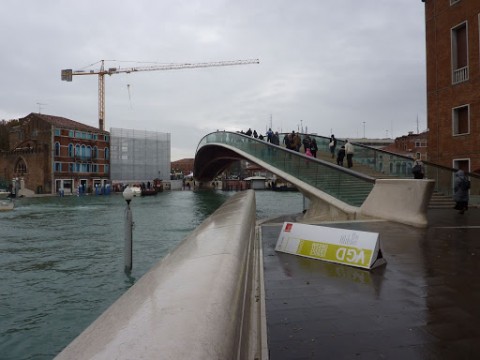
So Senor Calatrava’s practice designed an elegant bridge to solve the problem.
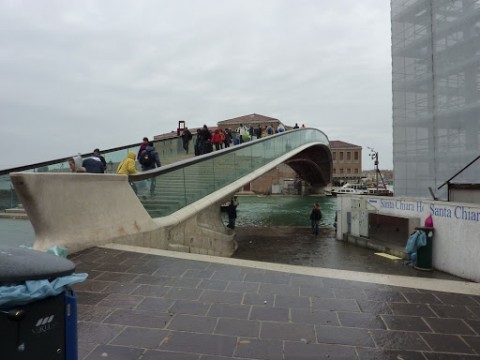
Salvation? Well, not quite. The seemingly irascible Venetians liked having their new bridge, but quibbled over some detailed points:
- No ramp facility for the disabled
- Steps that are shallow but uneven, though not shallow enough to enable a suitcase to be pulled over comfortably
- Cost to the Venetian public purse (see above) – around E20m, it appears.
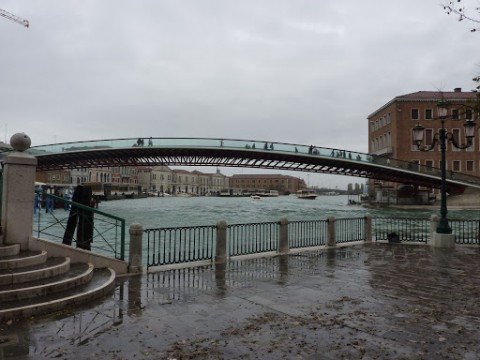
However, there it is, and if you want to observe the spirit of entrepreneurship that might modestly assist in pulling Europe out of its recessionary mire, you could do worse than note the (unofficial, it seems) porterage service that is offered to help you get over the bridge without testing the resilience of either your back or your luggage.
The author is a City of London and City of Westminster guide, who runs walking tours in the City and in Westminster. See tabs for further details.