
Walking Bridge Ward - a Few City Secrets
The Ward of Bridge is one of the 25 Wards that make up the administrative districts of the City of London. For most of us, the Ward connotation surfaces only when we are called upon to vote in local authority elections, but the richness of the City’s culture and history means that each of its Wards is replete with interesting things to see and talk about.
Thus I could not turn down a chance to be a guest on a walk around the Ward led by Paul Taylor of the Bridge Ward Club, renowned City Guide and Vice-President of the City of London Guide Lecturer's Association.
The Ward is small even in the context of the City’s compactness, stretching from the junction of Gracechurch Street and Fenchurch Street, south to the River Thames and then across London Bridge to the southern edge of the river, bordering on to Southwark.
......Yes, the City of London’s jurisdiction covers London Bridge, as well as also Tower Bridge, Southwark Bridge, Blackfriars Bridge, and more recently the Millennium Bridge that enables a virtually unfettered pedestrian walk from St Paul’s Cathedral to the Tate Modern Art Gallery (formerly Bankside Power Station).
The story of Bridge Ward is admirably detailed on the Ward Club’s website, so this blogpost will only display some photographs from the walk route with a commentary; but perhaps you might see a few things with which you are not familiar, even if you thought you knew the City reasonably well.
London Bridge naturally figures large in the history of Bridge Ward. In the precincts of the Church of St Magnus the Martyr, along the line of route to the old Bridge but now burdened with the traffic noise from Lower Thames Street, are some relics of the Bridge and the riverside.
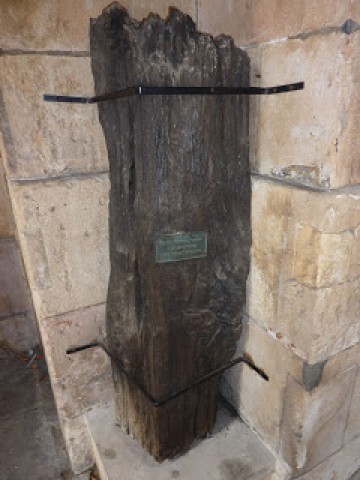
This fragment was not from the first bridge but from the wharfside. The plaque says dated 75 AD and found in 1931 in the Fish Street Hill area.
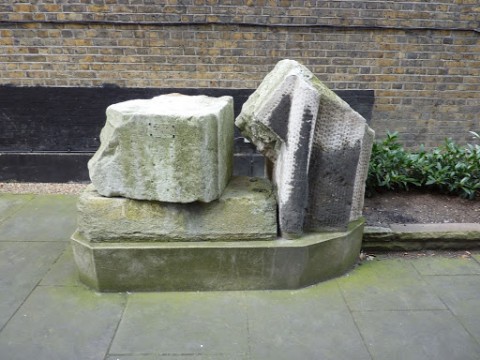
The first stone bridge lasted 656 years, despite the fact that by 1358 some 138 shops and houses had been built on it.
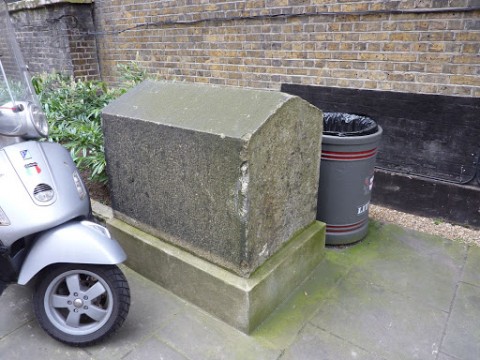
When the Rennie bridge deteriorated, it was dismantled and sold for £1m in 1968 to the US. It was then reassembled in Lake Havasu City in Arizona and stands there today. Folk of an unkindly disposition have suggested that the Americans thought that they were buying Tower Bridge.
London Bridge, and the other bridges mentioned above, are maintained by Bridge House Estates, for which the City of London Corporation is the trustee. The Estate has accumulated substantial investment funds over the years, partly due to the historic tradition of citizens making gifts of land and money “to God and the Bridge”.
The investment income grew to outweigh the cost of maintenance of the bridges, and so the surplus became channelled to City Bridge Trust. The tradition has been maintained, and the Trust reports today making grants of c. £15m per year towards charitable activity benefiting Greater London.
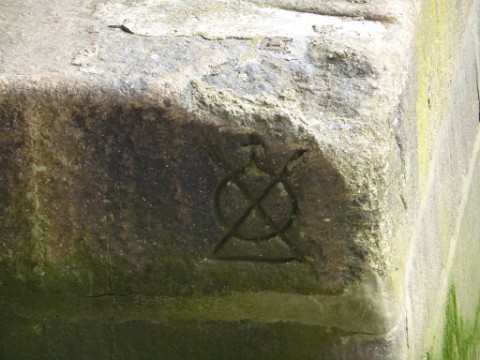
Bridge House Estates has a “bridge mark”.
The Fishmongers Company is one of the Great 12 Livery Companies. Its prestigious Hall sits in Bridge Ward, imposingly abutting the river. At the gated entrance to the Hall are statues of a fishmonger and his wife.
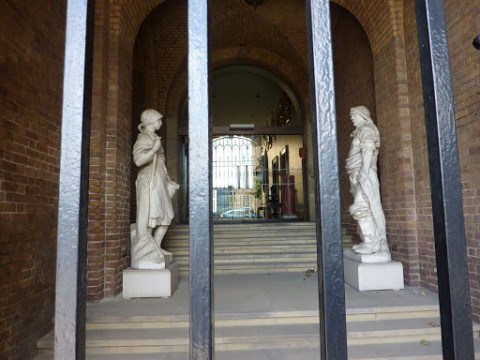
The statues are in Coade Stone. This is an artificial stone that wears well. It was created around 1770 by Mrs Eleanor Coade, the stone not apparently an original invention but a perfection of earlier processes. Whatever, this was a stunning example of a woman succeeding in "a man's world".
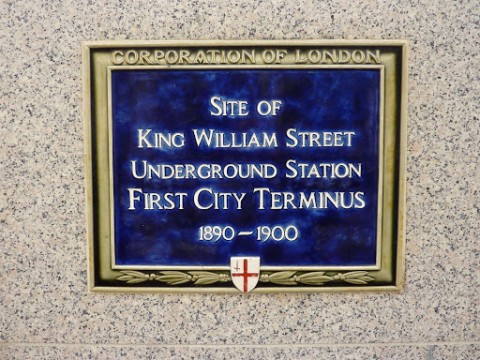
The Ward contains the plaque to the first City terminus for an Underground station, the line running from Stockwell and under the Thames.
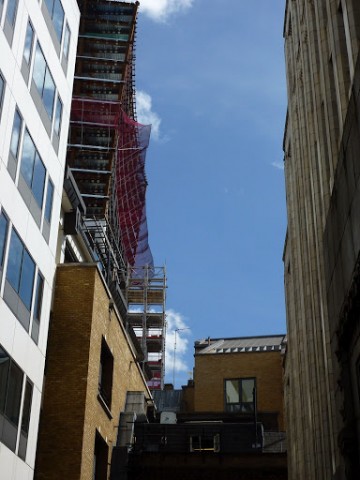
Ducking into Talbot Court, you get a view of a building under construction.
Moving up and away from the river, you catch sight of the building that Prince Charles described as being the likeness of a 1930s radio set.
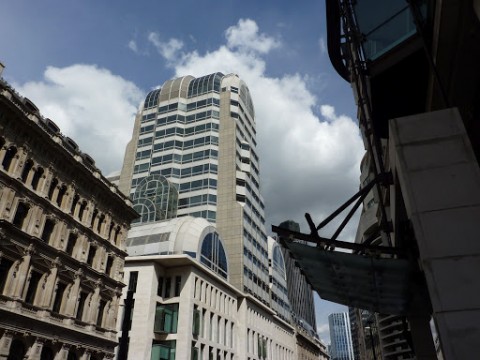
Retro radio sets have become popular with the advent of digital services. Might HRH now change his opinion if he were consulted?
Another courtyard, but this one hiding an 18th building. The City is not well-endowed with extant architecture of this period, so the site is worth noting.
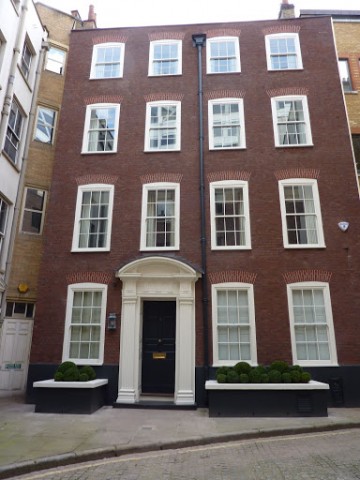
Pevsner dates the building as from the 1720s
The building under construction mentioned above comes into view, and signage shows that the marketing people have been hard at work.

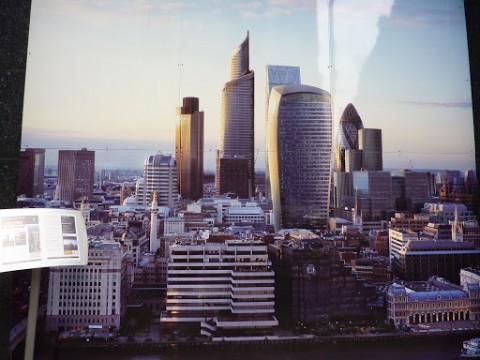
It is, of course, 20 Fenchurch Street, designed by architect Rafael Vinoly, and already nicknamed The Walkie Talkie - a development by Land Securities and The Canary Wharf Group.
And here is an almost spookily realistic hoarding photograph, showing a vision of this quarter of the City with the Walkie Talkie (in the foreground), and other proposed new developments, completed.
To finish with, and a complete contrast, we go from the large to the small. If you know where to look in Philpot Lane, still within Bridge Ward, you will see two (artificial) mice attached to a wall and vying over a piece of cheese.
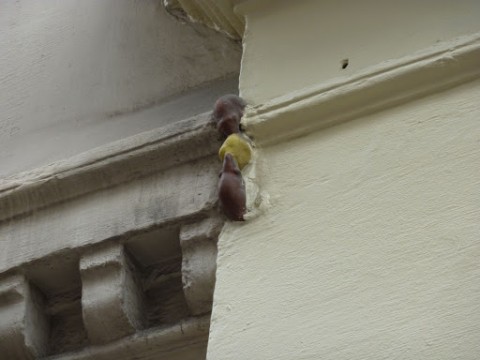
There are various stories associated with this phenomenon, but one is that during the construction of the building on this site, a workman accused another of stealing some of his lunch, and after an argument one of them fell to his death, only later it being found that mice were responsible for the theft.
However, to follow the tradition of the popular Discovering London walk, The Seven Noses of Soho, the exact location of the mice will not be revealed....
The author is a City of London and City of Westminster Guide, and former law firm partner, who runs walking tours in the City and in Westminster. See tabs for further details.