
Moses Montefiore - London and...Ramsgate
As a teenager growing up in the Isle of Thanet in Kent, I didn’t take much notice of road names.
I may have been able to deduce that The Plains of Waterloo in Ramsgate had something to do with a famous British military victory, but Grange Road in the same town was just another road, and certainly not recognised as the road leading to the house designed by Augustus Pugin and as became his family home from 1844 until his death in 1852.

Thus Montefiore Avenue was no more than a road with a pleasant name. Only years later did the scales drop.
The Bevis Marks Synagogue, in the eponymous street in the City of London, was completed in 1701 and is the spiritual home in the UK of the Spanish and Portuguese (Sephardic) Jews. More than that, it has been for long periods the religious centre of the Anglo-Jewish community.
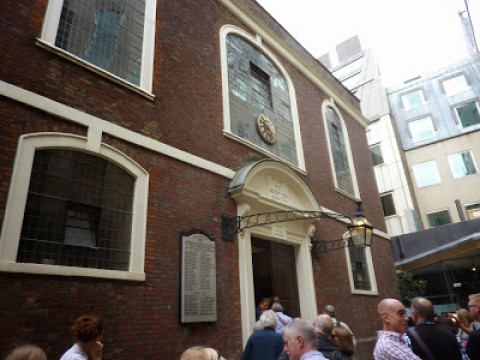
Amongst the members of its congregation was Moses Montefiore. Born in Livorno, Italy in 1784, he went to school in Kennington, South London, and started his working career apprenticed to a firm of grocers and tea merchants. From this modest start he rose to become a foremost financier in the City of London.
Having achieved business success, Montefiore developed into a social reformer and philanthropist. He was knighted in 1837, and in 1846 Queen Victoria conferred a baronetcy upon him in recognition of his services to humanitarian causes on behalf of the Jewish people.
In 1831 Montefiore purchased a house with 24 acres of estate on the East Cliff of the then fashionable seaside town of Ramsgate. The house had previously been in the ownership of Queen Caroline of Brunswick, the wife of King George IV, though her tenure as Consort was brief (1820 until her death in 1821) and controversial.
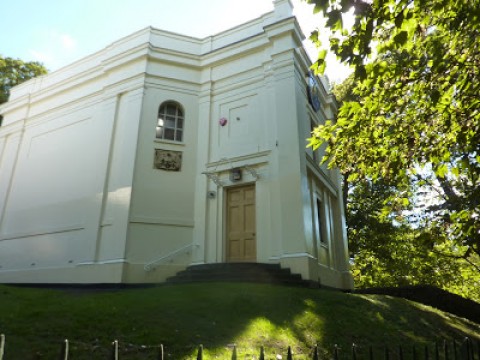
Soon after buying the estate, Montefiore bought adjoining land and instructed the architect David Mocatta to design a private synagogue for him. It was commissioned in June 1833.
180 years later, the synagogue is not easy to find. Directions instruct you to ascend a narrow lane between numbers 101 and 103, Hereson Road, Ramsgate. The mystery delivers a thrill when the building, designed in a restrained Classical-Italianate style, comes into view. The design apparently imitates that of Montefiore’s ancestral synagogue in Livorno (a spelling infinitely preferable to the ugly anglicised Leghorn).



I attended secondary school at Chatham House Grammar School in Ramsgate, the alma mater of the Rt. Hon. Edward Heath, former British Prime Minister. Being of a minority religion, Roman Catholic, I was excluded, alongside those of other minority religions, from the religious part of the school’s Anglican assembly.
Only in researching this blogpost did I learn that the land on which Chatham House’s Junior School still stands, is the site of the former Townley Castle College, opened in 1890 and described by the Jewish Standard of 5 September 1890 as a high-class boarding school for young Jewish gentlemen. For this and other information above I am indebted to www.JTrails.org.uk .The Jewish heritage of Ramsgate runs deep.
And the Bevis Marks Synagogue received only minor damage during the Blitz of World War II. There is something pleasing in writing that sentence.
The author is a City of London and City of Westminster Guide, who runs walking tours in the City and in Westminster. See tabs for further details.